Get THE APP

You see a laser facial advertised for $400 and think, "That's doable." Then at the consultation, you learn you need five sessions for optimal results. That's $2,000. Oh, and you'll need maintenance treatments every six months. Another $800 annually. Suddenly your "$400 treatment" is a $3,300 first-year investment.
Welcome to aesthetic treatment budgeting, where the sticker price is almost never the real price. Navigating the beauty industry can feel like you need an accounting degree just to understand what you're actually signing up for financially. Treatments are priced per session but sold as series. Maintenance schedules are lost in a sea of our hectic lives. And comparing treatments is nearly impossible when one costs $300 per session for six sessions and another costs $1,200 once.
In our collective years of navigating the beauty industry, what we’ve learned (and what we’re going to teach you) is to think about aesthetic treatment costs the way providers think about them: In total investment, not per-session pricing. So sit back, relax (maybe throw a sheet mask on), and learn how to calculate the real cost of treatments, compare apples to apples, and make decisions that fit your actual budget.
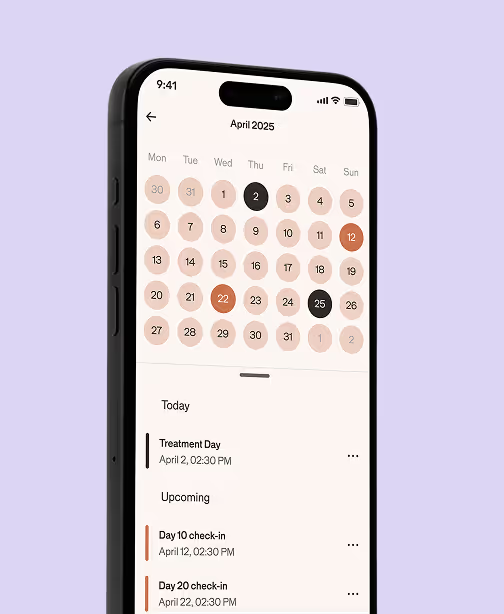
GlowGuide Tip: When you track treatments in GlowGuide, you can log total costs and see exactly what you've invested over time so you don’t have to guess whether that treatment series was worth it or if you've blown your budget without realizing it.
We’ve gone down many a late-night scrolling session rabbit hole. And fallen victim to questionable-at-best purchases. But when it comes to the aesthetic treatment algorithm, the old adage is accurate more often than not: If it seems too good to be true, it usually is.
For example; what you see advertised:
Very rarely are these one-and-done. Here’s what you can actually expect to pay:
The per-session price is just your entry point. The total investment is what you should expect to allocate.
Understanding how treatments are structured helps you budget accurately.
Providers love to sell packages, and they seem (and can be!) great, but how do you know if they’re actually in your best interest?
You should buy a package when:
You should avoid a package when:
GlowGuide Tip: Before buying a package, do ONE session first. Track it in the app with photos and notes. If your skin responds well and you're happy with the provider, then commit to the series.
Let’s say you’ve researched and found multiple treatments that claim to do similar things, but vary in prices, number of sessions needed, and required maintenance. Here’s how you can actually compare them:
Be specific. "I want to reduce pigmentation by 50%" or "I want to soften fine lines around my eyes" or "I want my skin to look brighter and more even."
Don't let them be vague. Press for specifics.
(Cost per session × number of sessions) + annual maintenance = Total
Total ÷ years of results = Annual cost
This is the number that matters.
Example:
Treatment A: $2,000 total, 3 months to see results, lasts 1 year = $2,000/year
Treatment B: $3,500 total, 6 months to see results, lasts 3 years = $1,167/year
Treatment B is actually cheaper long-term, even though it costs more upfront.
Goal: Addressing Fine Lines
Option A: Neurotoxins
Option B: RF Microneedling
5-year comparison:
RF microneedling: $3,200 + ($800 × 4 years) = $6,400 total
Neurotoxins: $1,400/year × 5 years = $7,000 total
RF microneedling has a higher upfront cost but is actually cheaper over time. However, they also address different mechanisms (collagen vs. muscle movement), so this only works if both solve your specific concern. The point isn't that one is "better", it's that you need to understand the total cost to make an informed decision.
Picture it: You get a treatment and it’s everything you dreamed about. You look in the mirror and oh, hi best self. The sun is shining a little brighter. Birds are singing. And then, weeks or months later, the metaphorical clouds roll in: You need another treatment. Now, this isn’t a bad thing, as long as you’ve planned for it.
In other words, some treatments hook you in with initial results, but the ongoing maintenance is where the real cost lives, and it can sneak up on you. The best way to approach any treatment is to take a hard look at their financial sustainability yellow flags.
Yellow flag #1: You're spending more on maintenance than your initial investment
If you spent $3,000 on a treatment and now spend $2,000/year maintaining it, it's time to reassess. At some point, the maintenance cost should decrease or you should graduate to a different treatment approach.
Yellow flag #2: You can't afford to stop
If stopping means you'll "lose" your results and you can't emotionally or aesthetically accept that, you're locked into a subscription you might not have intended to sign up for.
Yellow flag #3: You're stacking maintenance for multiple treatments
Botox every 3 months + filler every 6 months + laser facials quarterly = an unsustainable budget for most people. Something has to give.
Yellow flag #4: Results are diminishing but you're still paying
If your skin isn't responding as well as it used to but you're still doing treatments at the same frequency and cost, you're wasting money. Either increase intensity, change approaches, or accept that you've plateaued.
The good news is there are ways to escape the maintenance trap.
Option 1: Strategic pausing
Take 6-12 months off to see what your actual baseline is. Reassess which treatments genuinely made a difference. Restart only what delivered clear value.
Option 2: Switch to longer-lasting treatments
Trade frequent gentle treatments for less frequent aggressive ones. Instead of monthly microneedling at $350 × 12 = $4,200/year, do annual CO2 resurfacing at $3,500 with potentially better results.
Option 3: Shift to biostimulators
Trade hyaluronic acid fillers (lasting 6-12 months) for a biostimulator like Sculptra (lasting 2+ years). Higher upfront cost, lower annual maintenance.
GlowGuide Tip: Track your maintenance schedule in the app. Set reminders for when touch-ups are "due" based on your provider's recommendation, then honestly assess whether you still see value. If you're maintaining out of habit rather than results, it's time to pause.
Let's get real about what you can actually afford. Your favorite influencer tells you that monthly microneedling, quarterly lasers, ‘tox every 3 months, annual filler touch-ups, and luxury skincare will give you flawless skin forever.
Here’s what that actually costs:
TOTAL: $9,500/year
Most people can't spend $9K annually on their face. So let’s look at three examples of more realistic budgets.
Strategy:
What you can do:
Example allocation:
Total: $2,800/year
Strategy:
What you can do:
Example allocation:
Total: $5,000/year
Strategy:
What you can do:
Example allocation:
Total: $10,000/year
For so long, we’ve thought of treatments as a little treat. And, while they certainly can be, when you’re targeting specific results, you need to stop thinking aesthetics is a "splurge" category instead of a "recurring expense" category.
If you're serious about aesthetic treatments, you can't budget them like occasional indulgences. You need to treat them like your gym membership, your grocery budget, and even your healthcare spending.
What can you comfortably allocate monthly without stress? $100? $300? $500? Be honest.
Multiply by 12 = your annual aesthetic budget.
Map out the year with your budget allocated (GlowGuide helps you plan this visually; you can see your treatment schedule alongside your budget and adjust accordingly).
Log in GlowGuide:
Without tracking, you're guessing. By using data, you're making informed decisions.
Expensive treatments can be great, but unless the very real possibility of wasting money is your jam, the real luxury is knowing exactly what you're getting for your money and making choices that actually align with your budget and goals.